
Tuesday, December 18, 2012

Monday, August 6, 2012
Singapore tops world in Olympic gold medal cash payout
Singapore tops world in Olympic gold medal cash payout
By Elizabeth Soh | Fit To Post Sports – Sun, Aug 5, 2012 7:46 PM SGTIf there's a medal for the highest cash payout for winning an Olympic gold, Singapore would top the charts.
According to a story by broadcaster CNBC, it said Italy was the most generous with a S$225,000 (USD 182,400) payout for gold, followed by Russia with S$167,000.
France rounded up the top 3 with an S$80,000 payout.
In contrast, US gold medal winners only pocket $31,000 for gold, S$18,000 for silver and S$12,000 for bronze.
However, the CNBC story obviously did not include Singapore.
Under the Multi-Million Dollar Awards Programme (MAP), Olympic gold medal champions in individual events stannd to win S$ 1 million, S$500,000 for silver and S$250,000.
For example, Feng Tianwei's bronze medal victory in the women's single of the table-tennis will earn her a quarter of a million dollars
.
However, she has to plough a mandatory 20 per cent back into the National Sports Association for future training and development.
Although there is no definitive list of cash incentives paid out for Olympic gold, a quick check online reveals that other South-east Asian countries can also be pretty generous.
Singapore's closest neighbour, Malaysia, have the second biggest offer -- one million ringgit, or almost S$400,000 for a gold.Both Singapore and Malaysia have never won the gold medal at the Olympics.
The Philippines is third with S$380,000.
In contrast, gold medal athletes from traditional Olympic heavyweights receive significantly less.
Chinese-language Sports Weekly reported that gold medlalists at the last Beijing Olympics received just US$51,000, or 350,000 yuan.
Japan is more generous, paying its top medalists US$100,000, a similar amount to Russia's $135,000 reward
Athletes from host-country Britain will have to contend with just pats on their back and basking in the glow of doing their country proud -- British cyclist Bradley Wiggins, and rowers Helen Glover and Heather Stanning, all of whom won gold, will receive nothing.
Still, countries like the USA, Britain, and Japan have thriving sports industries which fight to offer gold medallists sponsorships worth millions - - far more than the cash they receive for winning.
It's been reported that Michael Phelps' endorsement with Nike is worth a reported US$50 million.
Over in Malaysia, badminton star Lee Chong Wei -- who narrowly lost to Lin Dan in Sunday's gold medal final -- stood to win 2 million Malaysian ringgit in cash or S$800,000 if he had brought him the country's first-ever gold, according to Malaysian daily The Star.
RM 1 million would have been from the Government through the National Sports Council's (NSC) incentive scheme and another RM 1 million cash from local furniture company 3V Holdings Sdn Bhd.
He would also have won a 12.5kg gold bar worth RM2mil offered by gold mine owner and KL Racquet Club Bhd chairman Datuk Seri Andrew Kam as well as a lifetime monthly pension of RM5,000 under the NSC scheme.
For his silver medal win from the 2008 Beijing Games, Lee was awarded a Datukship by the Penang government, RM300,000 cash and a RM3,000 monthly lifetime pension, as well as two cars from Proton.
Top 10 countries with highest payouts for an Olympic gold medal
1. Singapore — S$1,000,000
2. Malaysia — S$400,000
3. Philippines - S$423,300 (according to 2008 figures)
4. Thailand - S$372,600 (according to 2008 figures)
5. United Arab Emirates - S$337,800
6 Italy - S$226,500
7 Russia - S$167,650
8 Japan - S$124,200
9 Bulgaria - S$95,100 (according to 2008 figures)
10 France - S$81,000
Congrats Michael Phelps! How much money did he and other Olympians make?
Congratulations Michael Phelps for becoming the Olympian with the most metals (21) and winning gold 17 times! So how much does Michael Phelps make from his victories? According to WikiAnswers, the USA gives $25,000 for gold, $15,000 for silver and $10,000 for bronze. That's not bad, $425,000 from the gold metals alone!
But according to some recent reports, Michael Phelps is going to have to pay $9,000 per gold metal.
That's crazy, especially since it's not a fraction of the cost gold finalists from Singapore receive.
Reward for Olympic metals by countries in dollars:
**The numbers below have not been independently verified and are a combination of rewards for the 2008 and 2012 Olympics.**
- athlete who can bring
- Singapore: Gold metal, $708,800
- Philippines: - Gold metal, $340,900
- President Gloria Macapagal-Arroyo on Friday raised the Olympic incentive to 15 million pesos (340,909 U.S. dollars) for any Filipino athlete who gets a gold medal in Beijing.
- Malaysia: Gold metal, $307,000
- Malaysia, which has never won an Olympic gold medal, is offering a bonus of one million ringgit (307,000 dollars) to any athlete who can bring home the top prize from this year's Beijing Games.
- Thailand: Gold metal, $300,000
- Thai gold medallist at the Beijing Olympics will be rewarded of 10 million baht (about 300,000 U.S. dollars), runner-up will get a six million baht bonus and bronze medallist four million baht.
- United Arab Emirates: Gold metal, $272,000
- Also silver medal winners would be paid just over $200,000 while those winning bronze would get $136,000.
- Russia: Gold metal, $100,000
- Russian gold medallists at the upcoming Beijing Olympics are to get a bonus of 100,000 dollars (63,700 euros), Russian Olympic supremo Leonid Tiagachov said.
- Japan: Gold metal, $100,000
- Bulgaria: Gold metal, $76,620
- Every Bulgarian athlete who wins a gold medal at the Beijing 2008 Olympic Games will receive a 100 000 leva bonus from the Bulgarian state.
- China: Gold metal, $51,000
- Central sports officials in China have not said how high the bonuses they give will be, but the Chinese-language Sports Weekly reported they are likely to hand gold medal winners 350,000 yuan ($51,000) each, plus big payments shared out from sponsors.
- Dominican Republic: Gold metal, $30,000
- Winners could also get a car. It is the first time the Dominican government has made such an offer.
- USA: Gold metal, $25,000
- The USOC gives $25,000 for gold, $15,000 for silver and $10,000 for bronze.
- Australia: Gold metal, $20,000
- Australian Olympians are expected to get a $20,000 government bonus for gold medals at Beijing - less than winners from the USA, Japan, Germany, Israel, Thailand, Malaysia, Greece and Russia.
Friday, August 3, 2012
Judo triumph after trauma
Judo triumph after trauma

American golden girls’ amazing paths to Summer Games glory
Last Updated: 8:09 AM, August 3, 2012
She’s spun the deepest pain imaginable into Olympic gold.
Kayla Harrison overcame injury and thoughts of suicide brought on by four years of sex abuse by her coach to become the first American to win gold in judo yesterday.
“I did it,” the Ohio native, 22, said after she defeated the UK’s Gemma Gibbons.
“This is the happiest I’ll ever feel in my life. I’m walking on clouds right now. My feet haven’t touched the ground yet. As far as the rest of my life goes, it was all about this moment. Everything that was sacrificed by myself, by my family, it was all for that, and it was worth it.”
Before her triumph, Harrison spent a few moments recalling her tortured past.
“I feel incredibly sad for that little girl,” she told London’s Telegraph, referring to her younger self.
“I can still see her. I can still see her crying her eyes out and not knowing how to escape. But I’m happy for her because I know she had the courage to say, ‘I won’t be a victim of sexual abuse.’ ”
Harrison was just 6 when her mom, Jeannie Yazell, a black belt, introduced her to judo. Two years later, it was clear the girl could be a star, and she began training with world-class expert Daniel Doyle, then 24.
For years, he took advantage of his relationship with Harrison and her family. He coached her to two national titles before she was 15, attended family barbecues and even baby-sat for her and her siblings — all while he was sexually molesting the girl.
“I was an emotional wreck, severely depressed, suicidal. I hated my life. Finally, it got to the point where I couldn’t take it anymore,” she told the paper.
Finally, she revealed her secret to another judo student, future fiancé Aaron Hardy, and he told her mother.
“It was devastating,” Harrison said. “When I was young, he [Doyle] would say, ‘We have to keep this between us or we will get into trouble,’ and, honestly, as I got older, I was pretty brainwashed. I knew it was wrong, but I thought I loved him and he loved me . . . My world revolved around Daniel. He was my sun. All I wanted to do was please him.”
Doyle pleaded guilty in 2007 to illicit sexual conduct for abusing Harrison at matches in Venezuela, Estonia and Russia beginning when she was 12. But she thinks the abuse may have started earlier.
He’s serving a 10-year prison sentence and has been expelled for life from USA Judo, the sport’s national governing body.
After Doyle was arrested, a traumatized Harrison reinvented herself at a training facility in Wakefield, Mass.
“To say that she’s a different person today — I don’t want to say that she’s done a 180, because Kayla was a strong-willed person and she was goal oriented,” said legendary judo coach Jimmy Pedro, who was at her side yesterday.
Two years ago, Harrison faced off against her molester at his sentencing.
“I was so scared,” she told the Telegraph. “I forgive him. I almost pity him . . . But I said my piece, told the judge the truth . . . It’s closure.”
She became world judo champ in 2010 and won bronze in the competition last year.
Four months ago, her Olympic dreams were suddenly in jeopardy after she suffered a knee injury while training in Japan. But she never doubted she would recover.
“I feel accomplished,’’ Harrison said after her gold-medal win yesterday. “I’m at peace with myself
Read more: http://www.nypost.com/p/news/national/judo_triumph_after_trauma_H5YGLRW9m2iRR9jBVANRPN#ixzz22YZrlvEj
The forgotten story of Sohn Kee-chung, Korea's Olympic hero
The forgotten story of Sohn Kee-chung, Korea's Olympic hero
A Korean athlete won the gold medal in the marathon at the 1936 Berlin Olympics as a member of the Japanese delegation
A Korean athlete won the gold medal in the marathon at the 1936 Berlin Olympics as a member of the Japanese delegation
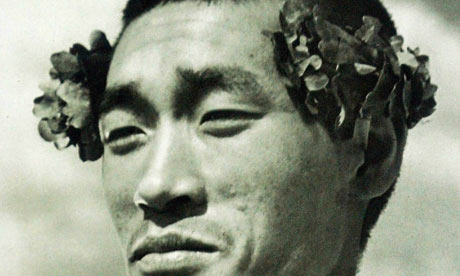
Sohn Kee-chung at the 1936 Olympic Games in Berlin, where he won a gold medal in the marathon. Photograph: Associated Press
Where does the story start? In the back of a taxi. It's as good a
place as anywhere. Maurice Greene arrived in Daegu this week. He took a
cab from the airport and when he was done he gave the driver a signed
picture of himself. The baffled cabbie did a double-take, then handed
Greene a photo back, taken of himself 20 years ago when he was working
as a fireman.
The sorry truth is that sports journalists always use taxi drivers as barometers of local opinion. It's a little lazy, but when you spend your days shuttling back and forth between the stadium and the hotel you don't get too much time to talk to the locals, and cabbies tend to be more forthcoming than waiters and stewards.
A lot of people in the athletics community are as confused about what they are doing in Daegu as Greene and that taxi driver were with their exchange. It's a pleasant but nondescript sort city, 2.5 million citizens and an hour's flight from Seoul. By coming here the IAAF are trying to take the sport to new markets, but the flip side of that is that these championships are being hosted by a country that has no great love for, or interest in, athletics. South Korea has never won a medal at a world championships, and it doesn't look like they are going to add to that tally in the next week.
And yet, despite that, there is a Korean hero at these championships His face is plastered on posters around the city, and his life story is written down in leaflets piled up at the information booths. The opening ceremony included a film of his life story. His name is Sohn Kee-chung, and while he may not be well known in the west, his autobiography is part of the school syllabus in South Korea. He died only eight years ago, but his life is already part of the national mythology.
You may not have seen it, but Sohn is the man at the centre of one of the iconic photographs of Olympic history. It is more understated than the snap of Tommie Smith and John Carlos giving the black power salute at Mexico '68, but just as powerful. It was taken on 9 August 1936, at the Olympic Stadium in Berlin. It shows three athletes on the podium during the medal ceremony of the Olympic marathon. At the back is the British silver medallist Ernie Harper. He is standing tall, shoulders back and head held high, a proud smile on his face. In front of him are two Korean runners, Sohn, gold medallist, and Nam Sung-yong, bronze medallist. Their heads are bowed and both are staring at their feet in, what they later called, "silent shame and outrage". Sohn is clutching a young oak tree to his chest. Nam would later say how envious he was of his team-mate. Not because of colour of his medal, but because unlike Sohn he had no oak tree to cover up the Japanese flag that was emblazoned across his shirt.
We remember the 1936 Olympics for Jesse Owens and his four gold medals. Sohn's was just as defiant a victory. And if history has forgotten that, it is because it was many years before the wider world realised the significance of what he did. Between 1910 and 1948 Korea was part of the Japanese empire, who suppressed the indigenous culture and language. The flags that were raised and the anthem that was played to salute Sohn and Nam were not Korean, but Japanese, and the press and the IOC did not award or record the victory as a Korean triumph, but a Japanese one. Sohn was not even allowed to compete under his own name, but went by the Japanese transliteration, Son Kitei.
"Japan produced three fine marathon runners in Son, winner of the marathon, Nan, third in the same race, and Kohei Murakoso, the only man who could give the Finns a race in the 5,000 and 10,000m," wrote E A Montague in the Manchester Guardian the day after the race. All three men were Korean.
During his stay in Berlin Sohn tried to tell the would that they should not think of him as Japanese. He would sign his name in Korean characters, and would often draw a small picture of his country alongside his autograph. After the race he tried to tell the newspapermen again and again that he was Korean, not Japanese, but his minders refused to translate his remarks. Montague's mistake was repeated right around the world, with one conspicuous exception. Back in Korea the newspapers blurred the Japanese flag out of the photographs of Sohn. The Korean daily Dong-A Ilbo, which still exists today, carried the photo – with the Japanese flag scratched out – on its front page on 25 August. Immediately afterwards the Japanese government shut the Dong-A Ilbo down for nine months and arrested, then tortured, eight of its journalists.
Sohn was born in Sinuiju, in what is now North Korea, in 1914, four years after the country was annexed by Japan. In school he was taught Japanese, and had to learn his own language in secret. He began to run, racing against friends on bicycles, and when his teachers realised how talented he was they sent him to study in Seoul. There he was coached by Lee Sun-il, who used to make him run with stones strapped to his back and his pockets filled with sand to help him build his strength and stamina.
The regime worked well. When he was 17, Sohn won his first marathon. And in the next five years, between 1931 and 1936, he would run in 12 more, winning nine of them. In November 1935 he ran the Tokyo marathon in 2hr 26min and 42sec, a world best, five minutes faster than the time that won Argentina's Juan Carlos Zabala gold at the 1932 Olympics. The next year Sohn finished third in the Olympic trial, behind his countryman Nam. The Japanese had made a lot of noise about how they intended to finish third in the medal table. They were happy to send the three Koreans to Berlin, a 12-day train journey away, to represent them in the marathon, so long as they ran under Japanese names and in the Japanese kit.
Zabala was the favourite for the race itself. He led the field out from the Olympic Stadium, the 56 runners trailing in his wake through the Grunewald forest. His fast pace meant he stretched out ahead of the pack. Sohn, 90 seconds behind after three miles, considered making a move to catch him. But as he set off he heard a voice come over his shoulder. It was Harper, the Englishman. "Take it easy," he said, "let Zabala run himself out." Sohn couldn't speak English, but he understood the sentiment. For the next 14 miles he and Harper ran together. And then, after 19 miles, the exhausted Zabala tripped and fell. Sohn and Harper passed him. Staggering and stumbling, Zabala dropped out two miles later.
Harper began to suffer with blisters, and his shoes filled with blood. Montague wrote afterwards that "Harper's performance, the last 10 minutes of it with a blistered and bandaged foot, can vie with Owens' sprinting as the finest performance of the Games." Sohn kicked on, racked with pain, his leaden legs pounding the tarmac track. "The human body can do so much," Sohn said later. "Then your heart and spirit must take over."
Heart and spirit carried him up one final slope, back into the stadium and across the line. As athletes always do, Sohn looked up at the scoreboard as he finished. He did not see his name, but the Japanese transliteration of it, and alongside it was not his nationality, but that of his nation's conquerors.
Soon after the race the Japanese athletes held a party to celebrate Sohn's victory. But neither he nor his team-mates were there. Instead they were at the house of An Bong-geun, a prominent member of the Korean nationalist movement. At An's house Sohn is said to have seen the Korean flag, forbidden from use, for the first time in his life. He was overcome with shame at the memory of being forced to wear the Japanese Rising Sun emblem in Berlin.
After the war, Sohn became the head coach of the Korean marathon team. Fourteen years on from Berlin, after Korea had been liberated from Japan and then occupied by the US and the Soviet Union, Sohn led a team of South Korean runners – the first athletes ever to wear the Korean flag on their kit – to a clean sweep in the 1950 Boston marathon. He was still coaching 42 years later, and was in the stadium in Barcelona to watch his protege, Hwang Young-jo, win South Korea's second Olympic gold in the marathon.
In his own country Sohn was already a hero. But it took 50 years for the rest of the world to acknowledge what he had done. He was an instrumental member of the Seoul Olympics Organising Committee, and it was only when Korea was awarded the Games that the athletics community rewrote the record books. In 1986 Sohn was invited to a ceremony in Culver City in California, where his nationality and name were changed on a monument to Olympic marathon winners. Two years later he carried the torch into the stadium for the opening ceremony of the 1988 Olympics, to a standing ovation from 80,000 of his countrymen.
"The Japanese could stop our musicians from playing our songs. They could stop our singers and silence our speakers," Sohn said before he died. "But they could not stop me from running.
The sorry truth is that sports journalists always use taxi drivers as barometers of local opinion. It's a little lazy, but when you spend your days shuttling back and forth between the stadium and the hotel you don't get too much time to talk to the locals, and cabbies tend to be more forthcoming than waiters and stewards.
A lot of people in the athletics community are as confused about what they are doing in Daegu as Greene and that taxi driver were with their exchange. It's a pleasant but nondescript sort city, 2.5 million citizens and an hour's flight from Seoul. By coming here the IAAF are trying to take the sport to new markets, but the flip side of that is that these championships are being hosted by a country that has no great love for, or interest in, athletics. South Korea has never won a medal at a world championships, and it doesn't look like they are going to add to that tally in the next week.
And yet, despite that, there is a Korean hero at these championships His face is plastered on posters around the city, and his life story is written down in leaflets piled up at the information booths. The opening ceremony included a film of his life story. His name is Sohn Kee-chung, and while he may not be well known in the west, his autobiography is part of the school syllabus in South Korea. He died only eight years ago, but his life is already part of the national mythology.
You may not have seen it, but Sohn is the man at the centre of one of the iconic photographs of Olympic history. It is more understated than the snap of Tommie Smith and John Carlos giving the black power salute at Mexico '68, but just as powerful. It was taken on 9 August 1936, at the Olympic Stadium in Berlin. It shows three athletes on the podium during the medal ceremony of the Olympic marathon. At the back is the British silver medallist Ernie Harper. He is standing tall, shoulders back and head held high, a proud smile on his face. In front of him are two Korean runners, Sohn, gold medallist, and Nam Sung-yong, bronze medallist. Their heads are bowed and both are staring at their feet in, what they later called, "silent shame and outrage". Sohn is clutching a young oak tree to his chest. Nam would later say how envious he was of his team-mate. Not because of colour of his medal, but because unlike Sohn he had no oak tree to cover up the Japanese flag that was emblazoned across his shirt.

We remember the 1936 Olympics for Jesse Owens and his four gold medals. Sohn's was just as defiant a victory. And if history has forgotten that, it is because it was many years before the wider world realised the significance of what he did. Between 1910 and 1948 Korea was part of the Japanese empire, who suppressed the indigenous culture and language. The flags that were raised and the anthem that was played to salute Sohn and Nam were not Korean, but Japanese, and the press and the IOC did not award or record the victory as a Korean triumph, but a Japanese one. Sohn was not even allowed to compete under his own name, but went by the Japanese transliteration, Son Kitei.
"Japan produced three fine marathon runners in Son, winner of the marathon, Nan, third in the same race, and Kohei Murakoso, the only man who could give the Finns a race in the 5,000 and 10,000m," wrote E A Montague in the Manchester Guardian the day after the race. All three men were Korean.
During his stay in Berlin Sohn tried to tell the would that they should not think of him as Japanese. He would sign his name in Korean characters, and would often draw a small picture of his country alongside his autograph. After the race he tried to tell the newspapermen again and again that he was Korean, not Japanese, but his minders refused to translate his remarks. Montague's mistake was repeated right around the world, with one conspicuous exception. Back in Korea the newspapers blurred the Japanese flag out of the photographs of Sohn. The Korean daily Dong-A Ilbo, which still exists today, carried the photo – with the Japanese flag scratched out – on its front page on 25 August. Immediately afterwards the Japanese government shut the Dong-A Ilbo down for nine months and arrested, then tortured, eight of its journalists.
Sohn was born in Sinuiju, in what is now North Korea, in 1914, four years after the country was annexed by Japan. In school he was taught Japanese, and had to learn his own language in secret. He began to run, racing against friends on bicycles, and when his teachers realised how talented he was they sent him to study in Seoul. There he was coached by Lee Sun-il, who used to make him run with stones strapped to his back and his pockets filled with sand to help him build his strength and stamina.
The regime worked well. When he was 17, Sohn won his first marathon. And in the next five years, between 1931 and 1936, he would run in 12 more, winning nine of them. In November 1935 he ran the Tokyo marathon in 2hr 26min and 42sec, a world best, five minutes faster than the time that won Argentina's Juan Carlos Zabala gold at the 1932 Olympics. The next year Sohn finished third in the Olympic trial, behind his countryman Nam. The Japanese had made a lot of noise about how they intended to finish third in the medal table. They were happy to send the three Koreans to Berlin, a 12-day train journey away, to represent them in the marathon, so long as they ran under Japanese names and in the Japanese kit.
Zabala was the favourite for the race itself. He led the field out from the Olympic Stadium, the 56 runners trailing in his wake through the Grunewald forest. His fast pace meant he stretched out ahead of the pack. Sohn, 90 seconds behind after three miles, considered making a move to catch him. But as he set off he heard a voice come over his shoulder. It was Harper, the Englishman. "Take it easy," he said, "let Zabala run himself out." Sohn couldn't speak English, but he understood the sentiment. For the next 14 miles he and Harper ran together. And then, after 19 miles, the exhausted Zabala tripped and fell. Sohn and Harper passed him. Staggering and stumbling, Zabala dropped out two miles later.
Harper began to suffer with blisters, and his shoes filled with blood. Montague wrote afterwards that "Harper's performance, the last 10 minutes of it with a blistered and bandaged foot, can vie with Owens' sprinting as the finest performance of the Games." Sohn kicked on, racked with pain, his leaden legs pounding the tarmac track. "The human body can do so much," Sohn said later. "Then your heart and spirit must take over."
Heart and spirit carried him up one final slope, back into the stadium and across the line. As athletes always do, Sohn looked up at the scoreboard as he finished. He did not see his name, but the Japanese transliteration of it, and alongside it was not his nationality, but that of his nation's conquerors.
Soon after the race the Japanese athletes held a party to celebrate Sohn's victory. But neither he nor his team-mates were there. Instead they were at the house of An Bong-geun, a prominent member of the Korean nationalist movement. At An's house Sohn is said to have seen the Korean flag, forbidden from use, for the first time in his life. He was overcome with shame at the memory of being forced to wear the Japanese Rising Sun emblem in Berlin.
After the war, Sohn became the head coach of the Korean marathon team. Fourteen years on from Berlin, after Korea had been liberated from Japan and then occupied by the US and the Soviet Union, Sohn led a team of South Korean runners – the first athletes ever to wear the Korean flag on their kit – to a clean sweep in the 1950 Boston marathon. He was still coaching 42 years later, and was in the stadium in Barcelona to watch his protege, Hwang Young-jo, win South Korea's second Olympic gold in the marathon.
In his own country Sohn was already a hero. But it took 50 years for the rest of the world to acknowledge what he had done. He was an instrumental member of the Seoul Olympics Organising Committee, and it was only when Korea was awarded the Games that the athletics community rewrote the record books. In 1986 Sohn was invited to a ceremony in Culver City in California, where his nationality and name were changed on a monument to Olympic marathon winners. Two years later he carried the torch into the stadium for the opening ceremony of the 1988 Olympics, to a standing ovation from 80,000 of his countrymen.
"The Japanese could stop our musicians from playing our songs. They could stop our singers and silence our speakers," Sohn said before he died. "But they could not stop me from running.
Thursday, August 2, 2012
China morning round-up
China morning round-up: Olympic badminton row
 Yu Yang (left) said on her microblog that she will quit badminton following the disqualification
Newspapers discuss the Olympic badminton row after eight players - including China's Wang Xiaoli and Yu Yang - were disqualified from the women's doubles competition.
The Badminton World Federation (BWF) disqualified the players for trying to lose in an apparent bid to secure an easier passage to the medal stages.
In regional newspapers such as Shanghai Daily it is the top story. Shanghai Morning Post described the punishment in a headline as "swallowing their own bitter fruit".
The reports, however, also say teams blamed the BWF's introduction of a round-robin stage rather than a knock-out tournament as the cause of the problem.
People's Daily Overseas Edition describes the punishment as "unprecedented", while its domestic edition says the event was "a crash of rules with ethics". It said the BWF should not punish players because of the federation's own problems.
Beijing News' editorial says the "utilitarian" and "shameful" act cheated the spectators. It also reminds athletes that on top of winning medals comes sportsmanship.
But a Global Times Chinese editorial asks people not to take the whole affair too seriously, because "all in all, the Olympic Games is a big party, everything to do with the Games should remain in the 'entertainment sport' level".
Meanwhile, Shanghai Daily and others celebrate the second gold medal won by women's swimming talent Ye Shiwen late on Tuesday, while papers including Guangzhou's Southern Metropolis Daily congratulate resident Lei Sheng for winning China's first-ever fencing Olympic gold.
Also on Thursday, China Daily and People's Daily report Premier Wen Jiabao has urged officials to prepare for a double typhoon with typhoons Saola and Damrey poised to hit eastern China.
Mr Wen said the forecasted movement of Typhoon Damrey has many similarities to that of Typhoon Nina in August 1975, which caused a series of dam collapses in Henan province, Shanghai Morning Post reports.
China Daily and the Global Times also report Beijing's protest over Washington's decision to place sanctions on the Bank of Kunlun - an affiliate of the China National Petroleum Corporation - for its ties with Iran.
China's foreign ministry urged the US to revoke the sanctions, said the reports.
The massive power cut in India provided China with a lesson to learn, a Global Times bilingual editorial says.
"As power consumption further rises, society has to develop a consensus on developing nuclear power, hydropower and clean energy," it said.
Wednesday, August 1, 2012
Olympics 2012
Fencer Shin refuses to accept 'special medal' after sit-in protest
By Sportsmail Reporter|
Fencing's governing body announced that heartbroken South Korean Shin A Lam will receive 'a special medal' after she felt she was robbed of a proper one in the women's epee on Monday night.
The medal will be for 'aspiration to win and respect for the rules,' said the International Fencing Federation in a statement.
But Shin said: 'It does not make me feel better because it's not an Olympic medal.
'I don't accept the result because I believe it was a mistake.'
Shin was speaking back at the ExCeL Arena, scene of the biggest controversy of the Games so far at the end of her semi-final with Germany's 2008 Olympic champion Britta Heidemann.
The 25-year-old was in floods of tears and stayed on the piste for over an hour while arguments raged about the result, but her defeat stood and she then lost the bronze medal match as well.
Shin thought she was through to the final when the clock went to zero, but Austrian referee Barbara Csar then ruled there was actually still a second left, during which time Heidemann scored.
Korean Olympic Committee president Park Yung-Sung revealed today the FIE had made the offer of a consolation prize and recognised that they had acknowledged that 'you can have human error.'
He added: 'They know they are very sorry about her and they have to recognise her sporting spirit.'
The FIE said they had, as yet, no confirmation of the date or place of the medal award ceremony.
The Korean team's protest was rejected this morning and Park also said: 'They cannot make a new decision after rejecting our appeal, but they are sorry and sympathise with Shin so they want to recognise her in the spirit of the Olympics.'
Shin, who said through an interpreter that she had slept for only about two hours last night, could still win a 'real' medal in the team event on Saturday - and could face Heidemann once more in the final.
Park blamed the timing system for the incident, claiming it was not accurate enough.
'They have never experienced this before with three attacks in the last second. Their timekeeping machine only has seconds, not fractions of a second. It cannot handle a situation like yesterday. That they admit.'
In their written appeal the Korean team had said: 'I can't agree with the decision of the referee. Who can believe this situation? The Korean team cannot accept this situation.'
But an official statement issued in response read: 'It is for the referee to decide how much time remains. The referee confirmed the last hit. Neither the DT (the technical director) nor the refereeing delegations can change a question of fact. The DT decides to reject the protest.'
Meanwhile, Park confirmed that the Korean team had accepted an apology from their Swiss counterparts after footballer Michel Morganella was expelled from the Games for directing an allegedly racist insult at South Koreans on Twitter.
The 23-year-old defender was sent home after posting the message in the wake of his team's 2-1 defeat to South Korea on Sunday. Morganella has also apologised and his Twitter account has been deleted
Read more: http://www.dailymail.co.uk/sport/olympics/article-2181812/London-2012-Olympics-Shin-A-Lam-refuses-special-medal.html#ixzz22MlmxSbH
The disgraceful moment eight Badminton players are KICKED OUT of the Olympics for deliberately trying to lose their games
Longest rally in one game between Korea and China was just four strokes- Locog said it would not refund tickets for the matches
- Lord Coe said: 'Depressing. Who wants to sit through something like that'
Eight women badminton players have been thrown out of the Olympics in disgrace for deliberately trying to lose their games.
Yesterday’s mass disqualification is unprecedented at an Olympic Games and followed uproar among 16,000 spectators, who booed their disgust at the players in the Wembley Arena on Tuesday night.
Four pairs – two from South Korea and one each from China and Indonesia – went to extraordinary lengths to avoid winning.
The players had all qualified for the quarter-finals of the women’s doubles and were accused of trying to manipulate the draw by losing so they would be matched with easier opposition in the next round or avoid playing their teammates.
Amid shameful and embarrassing scenes, players were deliberately serving into the net or hitting the shuttlecock over the court’s lines. The longest rally in one set lasted just four shots.
As a furious backlash grew, Lord Coe, head of London 2012, described the players’ actions as ‘depressing and unacceptable’.
The spotlight will be on the Chinese, who dominate world badminton but have been accused of manipulation before.
Petya Nedelcheva, a Bulgarian player who was on an adjacent court at the time of the first match, said Chinese players routinely tried to avoid playing each other.
She said: ‘China control everything. I don’t know who controlled the match to lose but if it is China again, they did it so many times last year – they didn’t play against each other in 20 matches. They do what they want.’
The Wembley fiasco began when Chinese top seeds Wang Xiaoli and Yu Yang started to show little interest in beating Koreans Jung Kyung-eun and Kim Ha-na to finish top of Group A.

Coming second would have meant avoiding compatriots and second seeds Tian Qing and Zhao Yunlei until the final.
The Koreans responded to China’s antics by copying them.
Referee Torsten Berg warned all the players and produced a black card, meaning they would be disqualified. After protests, this was rescinded.
The match restarted and the Koreans went on to win 21-14, 21-11.
The matter did not end there as a second Korean pair, third seeds Ha Jung-eun and Kim Min-jung, attempted to engineer defeat in their match against Indonesia’s Meiliana Jauhari and Greysia Polii.
Their motive was apparent retaliation to avoid Xiaoli and Yang in the quarter-finals, an outcome they failed to achieve as they won 18-21, 21-14, 21-12.
The Indonesians were not bystanders in the affair as they responded to the Koreans by trying to lose themselves.
Gail Emms, the former British badminton star and Olympic silver medallist, said: ‘You cannot do this in an Olympic Games, this is something that is not acceptable . . . it was just disgraceful.’
Miss Emms said the potential for match-fixing was raised in a managers’ meeting on Monday but the referee had dismissed concerns.
She added: ‘All the managers got together with the referee and said, “look, this has happened; in Group D you will find some very dodgy matches going on in the evening because of it” and the referee laughed and said “don’t be silly”.
‘The managers said “we know the game, we know the players and we know the teams and we know this is going to happen”.’
Korea’s coach Sung Han-kook laid the blame squarely at the feet of China. He said: ‘The Chinese started this. They did it first. They didn’t want to meet each other in the semi-final.’
The Badminton World Federation yesterday disqualified the players. Their places will be taken by the teams who finished third and fourth in their qualifying groups concerned – Canada, Australia, Russia and South Africa.
Locog said fans would not be given any refunds, even though some paid up to £80 to see the world’s best players. Chief executive Paul Deighton said: ‘You get in to all sorts of strange precedents if people aren’t satisfied with what they see – it is very grey and dangerous territory.’
Read more: http://www.dailymail.co.uk/news/article-2181902/Olympics-2012-Badminton-descends-farce-China-South-Korea-attempt-LOSE.html#ixzz22MopiATV
Tuesday, July 31, 2012
The next generation Y and their values
The Next Generation Y and their values
ST, 23 July 2012
Straits Times July 23, 2012
 SINGAPORE'S
'Linksters' view themselves as global citizens, are optimistic about
the future and their values are firmly entrenched in the family.
SINGAPORE'S
'Linksters' view themselves as global citizens, are optimistic about
the future and their values are firmly entrenched in the family.
These traits showed up when The Straits Times spoke to 200 students
between the ages of 13 and 19 last month. They were asked about their
social and economic backgrounds and current influences in face-to-face
interviews.
Broadly, they have grown up in small, more affluent households with an
average of 3.5 members. By contrast, the Department of Statistics had it
that the average teenager in 1970 grew up in a household with 5.4
family members, and in 1990, with 4.2 members.
Twenty years ago, just over half - or 51.5 per cent - of families lived
in HDB four-room flats or larger, including private housing. In 2010,
this number had jumped to 74.4 per cent. In the Straits Times poll, 167
lived in such flats, or 83.5 per cent, including private housing.
More than a quarter, 26.7 per cent of respondents, lived in households with a maid. Almost everyone had at least one computer at home - about 50 per cent had two or three. About 50 per cent also owned their own cameras and music players, while about 40 per cent had portable game consoles.
Culturally, Linksters feed off viral videos, ubiquitous social media and
live Twitter updates. The result: a heightened awareness of world
issues, even if they do not act on it. Up to 72.5 per cent agreed they
'felt strongly' on issues such as animal welfare and poverty, but only a
third - 32.1 per cent - were doing something about it.
Interview results also suggested an ambivalence towards local politics.
When asked if they felt they mattered in the development of public
policy, most indicated a 'neutral' response.
ike Gen Y a decade ago, many Linksters
grow up in homes with live-in maids; they have fewer siblings and more
disposable income.
Linksters come from even smaller households, where families have shifted
from a 'parent- centric' to a 'child-centric' dynamic, as sociologist
Tan Ern Ser of the National University of Singapore put it.
Their parents dote on them and shield them from hardships such as deprivation, he said.
But though they take these material things for granted, they say they do
not seek affluence. They aspire towards loftier ideals and, nurtured by
Internet connectedness, identify themselves as global citizens (see
table).
These results from The Straits Times' interviews echo the findings of
Singapore-based LifeWorkz, a training and management consultancy
specialising in work-life and generation issues.
Having observed qualitative focus groups of more than 500 young people
in four societies (China, India, Singapore and Hong Kong), it found that
teens today regard personal time as a 'premium commodity'. Globally,
Linksters are similar, they are less worried about bread-and-butter
issues and more likely to 'choose where they want to live, then find
work there'.
They set high career goals. 'For example, they will be asking to be
posted to London and New York, not the far-flung parts of China. There
is a lot of work in emerging countries, but this generation may not want
to go there,' said Ms Liew-Chng, referring to youth generally across
countries.
Associate Professor Tan calls them 'post-materialist', unconcerned about fulfilling basic needs because they have never had to worry about money. They are also less traditional in their ways.
Linksters use phones as an active medium - for exchanging news and
information, and to express themselves. Reaching a wide community
through a mobile phone tops their list of priorities.
But when it comes to work, being
'offline' is a prized commodity. For instance, they may not want to take
on jobs that require them to carry BlackBerry devices and answer e-mail
24/7. As consumers, this interconnectedness has made them a homogenous
demographic. Universally, Linksters are exposed to the same brands and
marketing, as geographical location has become irrelevant. As they come
of age, businesses, employers and even governments will want to steel
themselves for this demanding generation: They want things fast,
flexible and in tune with their beliefs. To meet the challenges of
crashing economies and global unemployment, they must be prepared.
They are not reticent, like Gen X-ers or Baby Boomers, about making themselves heard.


Subscribe to:
Posts (Atom)